Proportional Relationships Word Problems with Steps
Practice proportional relationship word problems and learn a step-by-step solving method with examples involving speed, shopping, recipes, and more.
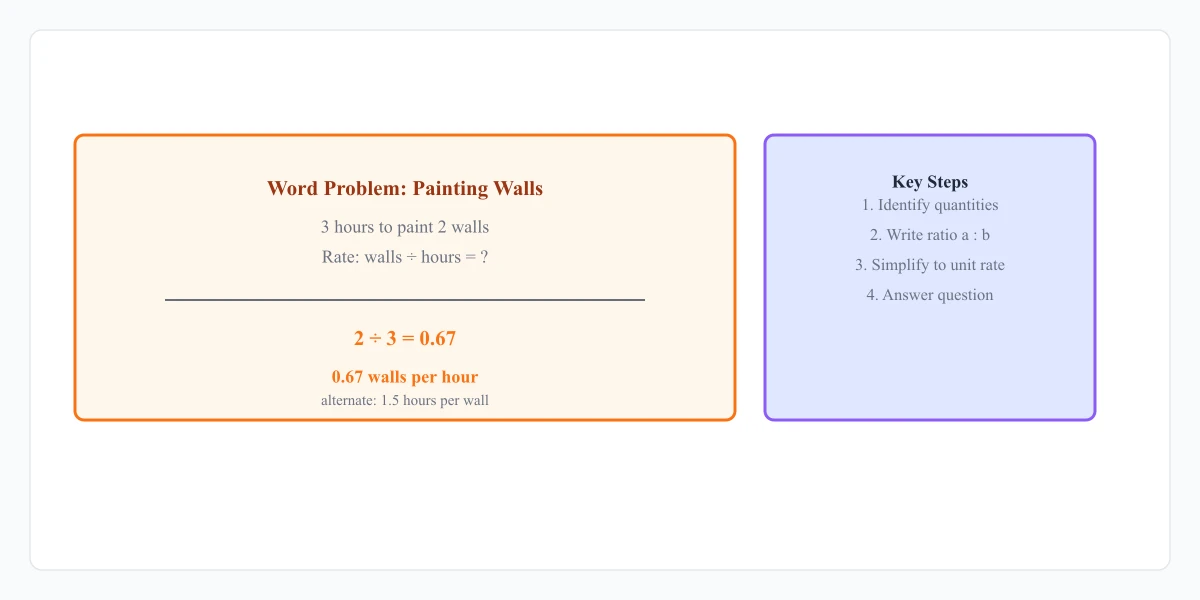
A recipe calls for 3 cups of flour for every 2 batches of cookies. You need to make 5 batches. How much flour do you need?
Most students know they should "do something with 3, 2, and 5." The trouble is figuring out what. This article gives you a repeatable method so you never guess again.
The Four-Step Method
Every proportional word problem follows the same structure. Learn these four steps and you can solve any of them.
Step 1: Identify the two quantities. Figure out what's being compared. These become your and .
Step 2: Set up the ratio. Write the known relationship as .
Step 3: Cross-multiply. Substitute the value you know and solve for the one you don't.
Step 4: Check your units. The answer should make sense in the real world.
Let's apply it.
Speed Problems: Distance = Rate Time
A car travels 180 miles in 3 hours at a constant speed. How far will it travel in 5 hours?
Step 1: Quantities are distance (miles) and time (hours). Distance depends on time, so distance, time.
Step 2: Find the unit rate.
Step 3: Write the equation and solve.
Step 4: 300 miles in 5 hours at 60 mph — makes sense.
| Time (hours) | Distance (miles) | | :-: | :-: | | 1 | 60 | | 3 | 180 | | 5 | 300 |
The proportion holds because both ratios equal 60.
Shopping and Unit Price Problems
A store sells 8 ounces of cheese for $5.20. How much would 13 ounces cost at the same rate?
Step 1: Quantities are cost (dollars) and weight (ounces). Cost depends on weight.
Step 2: Find the unit price.
Each ounce costs $0.65.
Step 3: Multiply.
Step 4: $8.45 for 13 ounces — about $0.65 per ounce, checks out.
The equation means any weight costs $0.65 per ounce. You can also solve this as a proportion:
Cross-multiply: , then .
Recipe Scaling Problems
A pancake recipe uses 2 eggs for every 3 cups of flour. To make a larger batch, you use 9 cups of flour. How many eggs do you need?
Step 1: Quantities are eggs and cups of flour.
Step 2: The ratio is the constant.
Step 3: , where is eggs and is flour.
Step 4: 6 eggs for 9 cups — triple the original recipe, triple the eggs. Correct.
Check: . Both simplify to the same ratio.
Free practice worksheet
Get a printable "Proportional Word Problems Practice" worksheet delivered to your inbox.
Map and Scale Problems
On a map, 1 inch represents 25 miles. Two cities are 3.5 inches apart on the map. How far apart are they in real life?
Step 1: Quantities are map distance (inches) and real distance (miles).
Step 2: miles per inch.
Step 3:
Step 4: 87.5 miles for 3.5 inches at 25 miles per inch — correct.
| Map Distance (in) | Real Distance (mi) | | :-: | :-: | | 1 | 25 | | 3.5 | 87.5 |
The proportion holds. Cross-multiply: .
Common Mistakes in Word Problems
Mixing up which quantity is and which is . In the speed problem, if you set time and distance, . The math still works but the units are awkward. Keep as the dependent quantity (what you're solving for).
Adding instead of multiplying. "3 cups for 2 batches, so 5 batches needs 3 + 2 + 5 = 10 cups." No. The relationship is multiplicative: .
Using the wrong pair in a proportion. If 3 inches on a map equals 75 miles, and you need to find what 5 inches equals, don't set up . The correct setup is .
Forgetting to check for reasonableness. If cheese costs $5.20 for 8 ounces, 13 ounces should cost more than $5.20. If your answer is $3.40, you divided instead of multiplied.
FAQ
How do I know which quantity goes on top in a proportion? Put the quantity you're solving for on top of one side, then mirror the unit on the other side. If solving for cost, put cost on top in both ratios.
What if the numbers aren't neat round numbers? Same method. works exactly like . Fractions and decimals don't change the steps.
Can I use cross-multiplication instead of finding ? Yes. Setting up and cross-multiplying is the same as finding the unit rate and scaling up. Use whichever you're more comfortable with.
How do I check if a word problem is proportional in the first place? Ask: does doubling one quantity double the other? If yes, it's proportional. Speed, unit price, simple recipes, and map scales are almost always proportional.
What if there's a starting fee? If the problem says "a $5 base fee plus $10 per hour," that's . Not proportional — the +5 breaks it. Look for "per," "each," or "every" without extra fees.
Do I always need to write the equation? No. Many students solve using only proportions: . But writing helps you see the structure, especially on multi-step problems.
What about inverse proportion word problems? Those use , not . If doubling one quantity halves the other, it's inverse. That's a different class of problem.
My teacher says to find the unit rate first. Is that always necessary? It's the most reliable method. Finding first means you always know the single step that connects any two values. You can solve any or with one multiplication or division.
Still stuck?
Get one-on-one help from a verified math tutor. Wyzant connects you with expert tutors who can walk you through proportional relationships step by step.
Find a math tutorPractice Problems
Try these on your own before checking the answers.
Problem 1: A bike travels 45 miles in 3 hours at a constant speed. How far will it travel in 7 hours?
Answer
mph. miles.
Problem 2: 6 apples cost $3.90 at the farmer's market. How much would 10 apples cost at the same rate?
Answer
per apple. y = 0.65(10) = \6.50$.
Problem 3: A map uses a scale of 0.5 inches = 20 miles. Two towns are 2.75 inches apart on the map. How far apart are they?
Answer
miles per inch. miles.
Problem 4: A cookie recipe needs 4 cups of flour for 3 batches. You want to make 8 batches. How much flour do you need?
Answer
cups per batch. cups.
Get free math resources
Join our newsletter and receive printable worksheets, practice sets, and tips for mastering proportional relationships.
No spam. Unsubscribe anytime.
Related: Review what a proportional relationship is or use the proportion solver to check your work on any set of values.
ProportionalRelationship Team
Math educator and content creator at Proportional Relationship.
Get free math resources
Join our newsletter and receive printable worksheets, practice sets, and tips for mastering proportional relationships.
No spam. Unsubscribe anytime.
Still stuck?
Get one-on-one help from a verified math tutor. Wyzant connects you with expert tutors who can walk you through proportional relationships step by step.
Find a math tutor