What Is a Proportional Relationship? Simple Explanation + Examples
Understand what a proportional relationship is, how to spot one from tables, graphs, and equations, and how to solve common class problems with step-by-step examples.
You have 30 pencils and 10 erasers. Are the quantities proportional? How do you know?
This is the kind of question that trips up students — not because it's hard, but because "proportional" sounds more complicated than it is. Here's what it actually means.
What Is a Proportional Relationship?
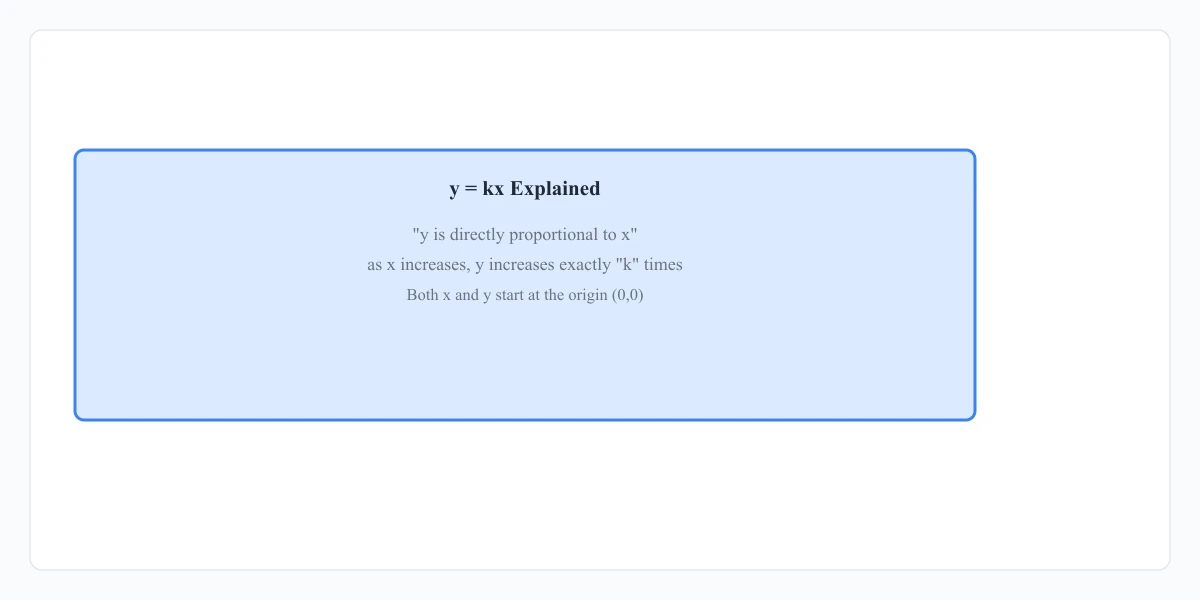
A proportional relationship is one where two quantities always change at the same rate. When one doubles, the other doubles. When one triples, the other triples. The ratio between them stays constant.
The math looks like this:
Where is the constant of proportionality — the fixed rate that connects the two quantities.
The Three Ways to Spot Proportional Relationships
Every proportional relationship can be identified three ways. If it passes all three, it's proportional.
1. Table: Constant Ratio
Take any two values in a table. Divide by . If you get the same number every time, you've found a proportional relationship.
| | | | | :-: | :-: | :-: | | 1 | 3 | 3 | | 2 | 6 | 3 | | 3 | 9 | 3 | | 5 | 15 | 3 |
Every pair gives 3. That's , so . Proportional.
Try a non-proportional table:
| | | | :-: | :-: | | 1 | 4 | | 2 | 7 | | 3 | 10 |
— the ratios change. Not proportional.
2. Graph: Straight Line Through the Origin
A proportional graph is always a straight line that passes through . Every time.
If the line is straight but starts at instead of , it's not proportional — even though it looks similar.
Use our graph proportional checker to test any set of points instantly.
3. Equation: Form
If you can write the relationship as with no extra constant added or subtracted, it's proportional.
- — proportional ()
- — proportional ()
- — not proportional (the breaks it)
Real-Life Examples
Buying gas. If gas costs $4 per gallon, the total cost is where is gallons. Double the gas, double the cost. That's proportional.
Walking speed. You walk 3 miles per hour. Distance where is hours. Two hours = 6 miles. Four hours = 12 miles. Proportional.
Pizza delivery fee. A pizza costs $10 plus a $5 delivery fee. Total . Order two pizzas and the fee doesn't double. Not proportional.
Free practice worksheet
Get a printable "Proportional Relationships Practice Pack" worksheet delivered to your inbox.
Common Mistakes
- Thinking "straight line" is enough. A straight line that doesn't go through the origin is not proportional.
- Dividing wrong. Always divide by , not by .
- Forgetting . In a proportional relationship, when , must be 0.
FAQ
What is a proportional relationship in simple terms? It means two quantities rise and fall together at the same rate. The ratio is always the same number.
What is the constant of proportionality? It's the fixed number in . It tells you how much changes when changes by 1.
Can a proportional relationship have negative numbers? Yes. If is negative, one quantity increases while the other decreases. The ratio still stays constant.
What's the difference between proportional and equivalent? Equivalent ratios are ratios that simplify to the same value. A proportional relationship is any relationship where all ratios are equivalent.
Do all proportional relationships start at zero? Yes. When , must equal 0 in a proportional relationship like .
Still stuck?
Get one-on-one help from a verified math tutor. Wyzant connects you with expert tutors who can walk you through proportional relationships step by step.
Find a math tutorPractice
Check whether each relationship is proportional:
- — proportional or not?
- Table:
- A graph passes through and — proportional?
Get free math resources
Join our newsletter and receive printable worksheets, practice sets, and tips for mastering proportional relationships.
No spam. Unsubscribe anytime.
Related: Use our proportional relationship calculator to check any set of values, or read about the constant of proportionality to go deeper.
ProportionalRelationship Team
Math educator and content creator at Proportional Relationship.
Get free math resources
Join our newsletter and receive printable worksheets, practice sets, and tips for mastering proportional relationships.
No spam. Unsubscribe anytime.
Still stuck?
Get one-on-one help from a verified math tutor. Wyzant connects you with expert tutors who can walk you through proportional relationships step by step.
Find a math tutor