Unit Rate vs Ratio: What's the Difference?
Learn the difference between ratio, rate, and unit rate with real-life examples and a step-by-step comparison table.
A 12-pack of soda costs $6. A 6-pack costs $3.50. Which is the better deal?
The answer depends on unit rate — and confusing it with a simple ratio leads to the wrong choice.
Ratio vs. Rate: The Core Difference
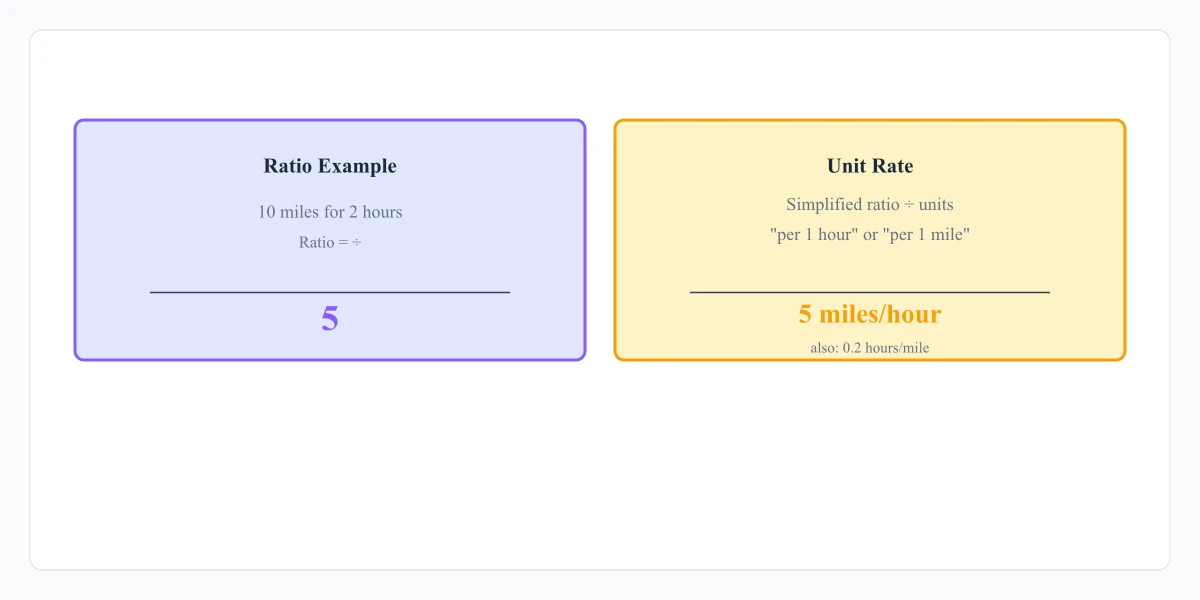
A ratio compares two quantities using division: or . It doesn't care about units or the number 1.
A rate is a ratio where the two quantities have different units: miles per hour, dollars per pound, students per teacher.
A unit rate is a rate where the second quantity is 1. It tells you "how much per one."
| Concept | Example | Second quantity | |---|---|---| | Ratio | or | Any number | | Rate | 60 miles per 2 hours | Any number | | Unit rate | 30 miles per 1 hour | Always 1 |
Free practice worksheet
Get a printable "Unit Rate Mastery Pack" worksheet delivered to your inbox.
How to Find a Unit Rate
Divide the first quantity by the second. That's it.
Example: You drive 150 miles in 3 hours.
Your unit rate is 50 mph.
Example: A 12-pack costs $6.
Each can costs 50 cents.
Why Unit Rate Wins
The unit rate lets you compare anything. Back to the soda:
- 12-pack: \6 \div 12 = $0.50$ per can
- 6-pack: \3.50 \div 6 = $0.58$ per can
The 12-pack is cheaper per can. Without unit rate, you might guess the smaller pack is a better deal because the total price is lower.
When to Use Ratio vs. Unit Rate
| Situation | Use | Example | |---|---|---| | Comparing parts of a whole | Ratio | 3 boys for every 4 girls | | Comparing different units | Unit rate | 50 miles per hour | | Scaling a recipe | Ratio | 2 cups flour : 1 cup sugar | | Finding the best price | Unit rate | Price per ounce | | Describing speed | Unit rate | Meters per second | | Comparing class sizes | Rate | 20 students per teacher |
Real-World Examples
Grocery shopping. A 24-ounce jar of pasta sauce costs $3.60. A 32-ounce jar costs $4.80.
- 24-oz: \3.60 \div 24 = $0.15$ per ounce
- 32-oz: \4.80 \div 32 = $0.15$ per ounce
Same unit rate. Buy whichever size you need.
Running pace. You run 5 miles in 40 minutes.
That's your pace — a unit rate. Compare this to a friend who runs 7-minute miles, and you know who's faster.
FAQ
Is every ratio a rate? No. A ratio can compare any two numbers (like 3 : 4). A rate specifically compares quantities with different units.
Is every rate a unit rate? No. A rate can have any number as the second quantity. A unit rate always has 1 as the second quantity.
How do you write a unit rate? As "something per one something else": miles per hour, dollars per pound, words per minute.
What's the difference between unit rate and unit price? Unit price is a type of unit rate specifically about cost per unit of measure. All unit prices are unit rates, but not all unit rates are prices.
Do unit rates always use division? Yes. You always divide the first quantity by the second to get a unit rate.
Still stuck?
Get one-on-one help from a verified math tutor. Wyzant connects you with expert tutors who can walk you through proportional relationships step by step.
Find a math tutorRelated: Try the unit rate calculator, or read real-life unit rate examples for more context.
ProportionalRelationship Team
Math educator and content creator at Proportional Relationship.
Get free math resources
Join our newsletter and receive printable worksheets, practice sets, and tips for mastering proportional relationships.
No spam. Unsubscribe anytime.
Still stuck?
Get one-on-one help from a verified math tutor. Wyzant connects you with expert tutors who can walk you through proportional relationships step by step.
Find a math tutor