Proportional vs Nonproportional Relationships
Compare proportional and nonproportional relationships using graphs, tables, equations, and real-world examples with clear side-by-side comparisons.
You're comparing two cell phone plans. One charges $10 per gigabyte of data. The other charges $5 per gigabyte plus a $20 monthly base fee.
Both look like straight lines on a graph. Both charge per gigabyte. But one is proportional and the other is not. The difference? That $20 base fee.
Here's how to tell them apart — every time, in every format.
The Core Difference in One Sentence
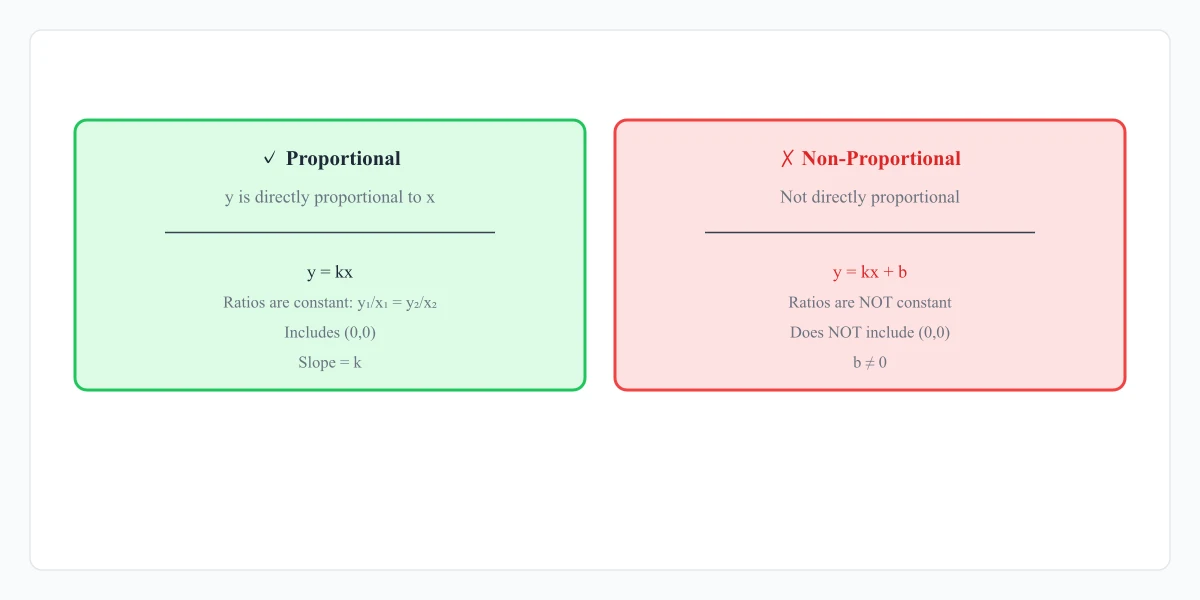
A proportional relationship follows (no added constant). A nonproportional relationship follows (shifted by ).
That — the constant added or subtracted — is the only thing separating proportional from nonproportional.
Side-by-Side: Tables
Compare these two tables. Both are linear. Only one is proportional.
| | Proportional | | | :-: | :-: | :-: | | 1 | 5 | 5 | | 2 | 10 | 5 | | 3 | 15 | 5 | | 4 | 20 | 5 |
| | Nonproportional | | | :-: | :-: | :-: | | 1 | 7 | 7 | | 2 | 12 | 6 | | 3 | 17 | 5.67 | | 4 | 22 | 5.5 |
Left table: every equals 5. Constant ratio. . Proportional.
Right table: the ratios change (7, 6, 5.67, 5.5). The values increase by 5 each time, but they start at 7 instead of 5. This is . Not proportional.
The test: divide by . Same every time = proportional. Different = not proportional.
Side-by-Side: Graphs
Both lines below are straight. Both have the same steepness. Look where they cross the -axis.
- Proportional: crosses at . Line: .
- Nonproportional: crosses at . Line: .
Same slope. Same angle. But that 2-unit shift up changes everything. A line through the origin is proportional. A line shifted off the origin — even by 0.1 — is not.
The test: check . If the line goes through it, check ratio consistency. If not, done — not proportional.
Side-by-Side: Equations
| Proportional | Nonproportional | |---|---| | | | | | | | | | | | |
Left column: form only. No , no . Right column: has a constant term that shifts the line.
The test: can you write it as with nothing added or subtracted? If yes, proportional. If you need or , it's not.
Why the Origin Matters
The origin rule comes straight from the equation. In :
Plug in , and must be 0. In :
Plug in , and . That is the shift.
In real terms, means "something is already there before you start." That's a base fee, a starting charge, an initial distance — anything that exists at zero quantity. Proportional relationships have none of that. Zero of one means zero of the other.
Real-World Examples
Proportional: Gas costs $4 per gallon. Buy 0 gallons = pay $0. Buy 5 gallons = pay $20. Buy 10 = $40. Every gallon adds exactly $4.
Nonproportional: A cell plan costs $5 per GB plus a $20 base fee. Use 0 GB = still pay $20. Use 5 GB = pay $45 ($25 data + $20 fee). Use 10 GB = pay $70. The fee doesn't multiply.
The fee turns a proportional relationship into a nonproportional one. That $20 is .
Quick Reference
| Feature | Proportional | Nonproportional | |---|---|---| | Equation form | | () | | Graph | Straight line through | Straight line shifted off origin | | Table ratios | Constant ( same) | Changing ( differs) | | gives | | | | Real example | Pay per hour with no base | Pay per hour with sign-up fee |
Practice: Identify Proportional or Not
1. Table:
| | | | :-: | :-: | | 2 | 8 | | 5 | 20 | | 7 | 28 |
, , . Constant ratio. Proportional. .
2. Graph: A straight line passes through and .
The line doesn't pass through . Not proportional. (It's .)
3. Equation:
Has a constant. Not proportional.
4. Word problem: A baker uses 2 cups of flour for every 12 cookies. Write the relationship.
No added constant. When the baker makes 0 cookies, they use 0 cups of flour. Proportional.
Free practice worksheet
Get a printable "Proportional vs Nonproportional Practice Pack" worksheet delivered to your inbox.
FAQ
Is a nonproportional relationship still linear? Yes. is linear — it graphs as a straight line. The "nonproportional" label means it doesn't pass through the origin, not that it's curved.
Can a relationship be proportional if is negative? Yes. is proportional. The line goes through the origin and has a constant ratio (). It just points downward.
What if a table has and but ratios differ later? Not proportional. The origin is necessary but not sufficient. You still need every to match. Check non-zero rows to be sure.
How do I know from a graph? Look at the -intercept — where the line crosses the -axis. That point is . If , it's nonproportional.
What if the equation is ? That's just . Proportional. means no shift. Most teachers won't write the , but if they do, it's still proportional.
Do all proportional relationships have a -intercept of 0? Yes. In , when , . The line always passes through . That's the definition.
Can a nonproportional relationship have a constant ? No. If is constant, the relationship is by definition, which means and it's proportional.
What's the difference between and ? Nothing, when the line goes through the origin. In , is the slope. In , is the slope. Same number, same meaning — the rate of change. The only difference is the .
Get free math resources
Join our newsletter and receive printable worksheets, practice sets, and tips for mastering proportional relationships.
No spam. Unsubscribe anytime.
Still stuck?
Get one-on-one help from a verified math tutor. Wyzant connects you with expert tutors who can walk you through proportional relationships step by step.
Find a math tutorRelated: Review the common mistakes students make or get a full breakdown of why the equation is . Use our graph checker, table checker, or equation checker to instantly check any relationship.
ProportionalRelationship Team
Math educator and content creator at Proportional Relationship.
Get free math resources
Join our newsletter and receive printable worksheets, practice sets, and tips for mastering proportional relationships.
No spam. Unsubscribe anytime.
Still stuck?
Get one-on-one help from a verified math tutor. Wyzant connects you with expert tutors who can walk you through proportional relationships step by step.
Find a math tutor