Why Proportional Relationships Look Like y = kx
Understand why proportional relationships are written as y = kx and what each part means, with tables, graphs, and real-life connections.
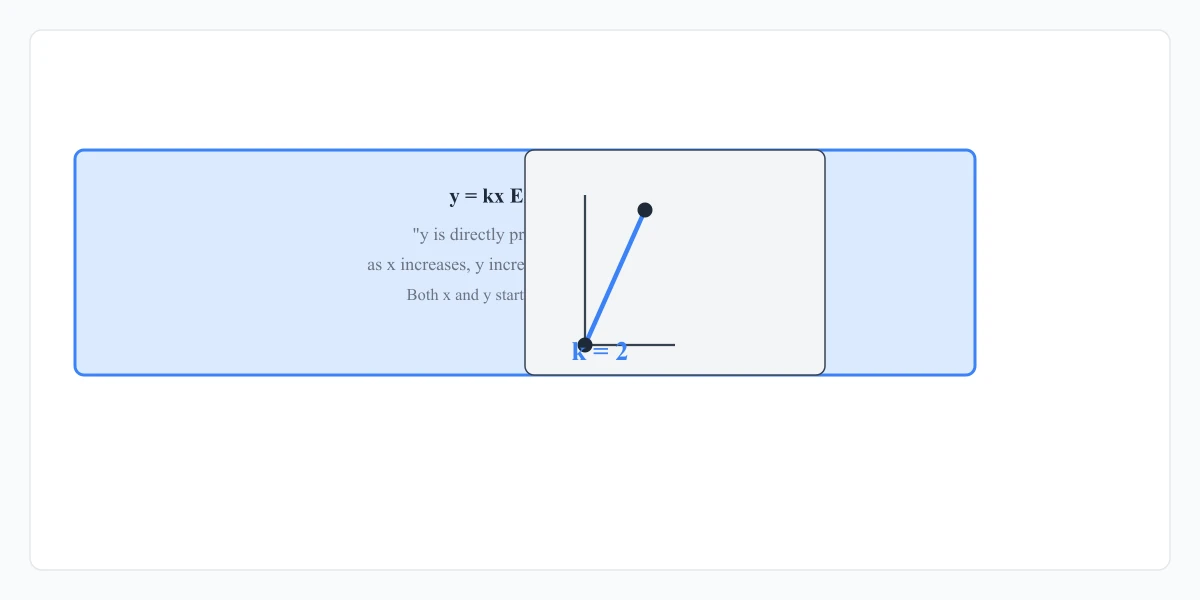
Why ? Why not ? Why not ?
The equation isn't arbitrary. It's the direct result of what a proportional relationship actually is: two quantities that change at a fixed, constant rate.
What Each Part Means
- — the dependent quantity (what you're figuring out)
- — the constant of proportionality (the fixed rate)
- — the independent quantity (what you control)
If you're earning $15 per hour:
- = hours worked (you decide this)
- = 15 (fixed rate)
- = total pay (depends on )
Work 5 hours? y = 15(5) = \75$.
Free practice worksheet
Get a printable "Proportional Equations Practice" worksheet delivered to your inbox.
Why There's No
This is the most important detail. In , when , :
If the equation had a , like , then when :
A graph not passing through the origin. That extra means something is already there before you start — which breaks proportionality.
Proportional: You earn $0 when you work 0 hours. Not proportional: You get a $20 signing bonus plus $15 per hour.
Connecting Tables, Graphs, and Equations
The power of is that it unifies all three representations.
| Representation | Form | Example | |---|---|---| | Equation | | | | Table | Each is times | | | Graph | Straight line through | Slope |
If any representation gives you a different , something is wrong.
Finding in
Rearrange the equation:
For any point on a proportional relationship (except where ), dividing by gives .
A table shows . . The equation is .
A graph passes through . . The equation is .
What Looks Like
- can be a whole number:
- can be a fraction:
- can be a decimal:
- can be negative:
Every single one is a proportional relationship.
FAQ
What does represent in real life? Any situation where one quantity is a fixed multiple of another: pay by the hour, distance at constant speed, cost per item.
Is the same as ? Yes. They're identical. In proportional relationships, (slope) equals (constant of proportionality). Different letters, same meaning.
What if the equation is ? Not proportional. The shifts the line off the origin. This is a linear relationship but not a proportional one.
Can be negative in ? Yes. A negative means decreases when increases. The line still goes through the origin — it just points downward.
Why does the line always go through ? Because . When you have none of , you get none of .
Still stuck?
Get one-on-one help from a verified math tutor. Wyzant connects you with expert tutors who can walk you through proportional relationships step by step.
Find a math tutorRelated: Use the constant of proportionality calculator to find , or check if an equation is proportional automatically.
ProportionalRelationship Team
Math educator and content creator at Proportional Relationship.
Get free math resources
Join our newsletter and receive printable worksheets, practice sets, and tips for mastering proportional relationships.
No spam. Unsubscribe anytime.
Still stuck?
Get one-on-one help from a verified math tutor. Wyzant connects you with expert tutors who can walk you through proportional relationships step by step.
Find a math tutor