9 Common Mistakes in Proportional Relationships
Avoid the most common student mistakes when checking tables, graphs, and equations for proportionality — and learn how to fix each one.
Here are 9 mistakes students make on proportional relationship problems — each with the fix so you don't make them yourself.
1. Thinking Any Straight Line Is Proportional
A straight line is necessary but not sufficient. The line must also pass through . A straight line that starts at is not proportional — it's , not .
Fix: Always check first. If the line doesn't pass through the origin, stop. It's not proportional.
2. Dividing by Instead of by
Given the table row , some students compute instead of . This gives the wrong and can make a proportional table look non-proportional.
Fix: . Remember it as "output divided by input."
3. Ignoring the First Row of the Table
A table like this:
| | | | :-: | :-: | | 0 | 0 | | 2 | 6 | | 5 | 15 |
Some students see and increasing by 6 then 9 and think it's not proportional. But and . It's proportional — .
Fix: The origin is a starting point but doesn't give you . Check any two non-zero rows.
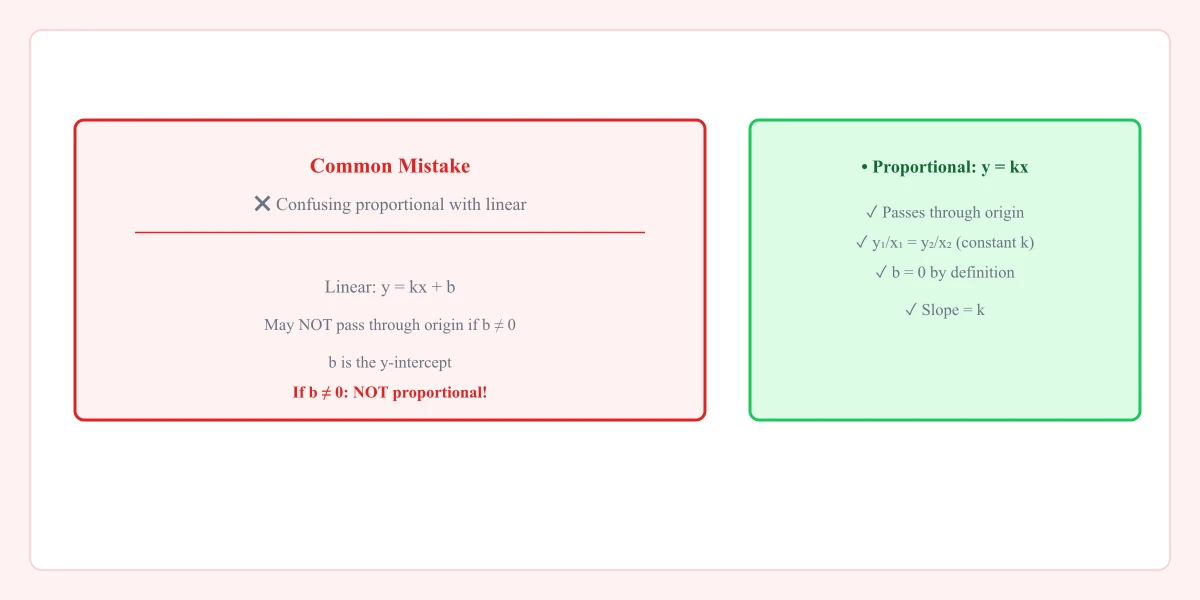
4. Confusing "Proportional" with "Linear"
All proportional relationships are linear, but not all linear relationships are proportional. A linear graph that doesn't go through the origin is still linear — it's just not proportional.
Fix: Linear = straight line. Proportional = straight line through the origin.
5. Forgetting That Can Be a Fraction
means . Some students see fractional ratios and assume the table isn't proportional.
Fix: doesn't need to be a whole number. Any consistent ratio counts.
6. Assuming Bigger Numbers = Not Proportional
Some students think that if numbers increase unevenly, the relationship can't be proportional. But:
| | | | :-: | :-: | | 4 | 10 | | 10 | 25 | | 20 | 50 |
. . Perfectly proportional.
Fix: The ratio matters, not the jump size.
7. Mixing Up Direct and Inverse Proportions
is direct proportion. is inverse proportion (as doubles, halves). These are different concepts, but students often treat them the same.
Fix: Direct proportion: one up, the other up. Inverse proportion: one up, the other down.
8. Guessing Instead of Computing
"I think these two ratios look the same" is not a valid check. Always divide.
Fix: Use a calculator. Two seconds of division saves points on the test.
9. Thinking the Constant of Proportionality Is Always the First
Given , some students say because it's the first number they see. But .
Fix: , not . Always divide.
Free practice worksheet
Get a printable "Common Mistakes Practice Worksheet" worksheet delivered to your inbox.
Quick Reference
| Mistake | Why It's Wrong | The Fix | |---|---|---| | Any straight line = proportional | Misses the origin check | Check | | instead of | Wrong value | | | Skipping the origin rule | Wrong conclusion | All points must pass | | Proportional = linear | Linear is broader | Line must pass through origin | | must be whole | False | can be any real number | | Guessing ratios | No evidence | Always divide | | = first value | Wrong | Divide by |
Still stuck?
Get one-on-one help from a verified math tutor. Wyzant connects you with expert tutors who can walk you through proportional relationships step by step.
Find a math tutorRelated: Check your work with our table checker, graph checker, or equation checker.
ProportionalRelationship Team
Math educator and content creator at Proportional Relationship.
Get free math resources
Join our newsletter and receive printable worksheets, practice sets, and tips for mastering proportional relationships.
No spam. Unsubscribe anytime.
Still stuck?
Get one-on-one help from a verified math tutor. Wyzant connects you with expert tutors who can walk you through proportional relationships step by step.
Find a math tutor