Scale Factor and Proportions Explained Simply
Learn how scale factor connects to proportional reasoning, similar figures, and geometry problems. Step-by-step examples with enlargements and reductions.
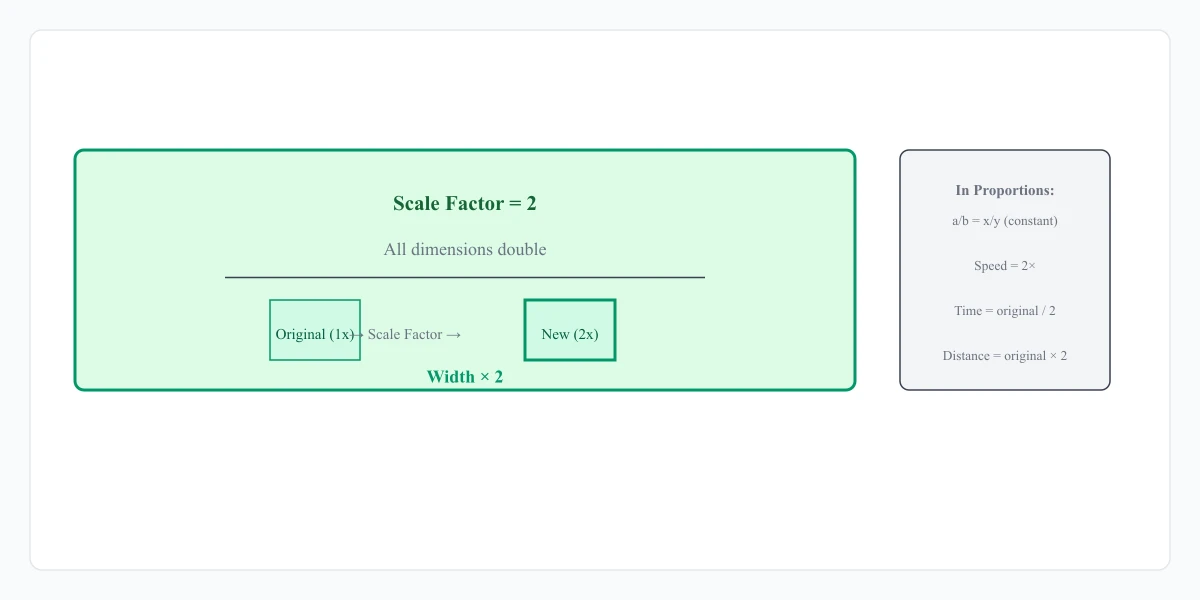
You take a 4 × 6 inch photo and enlarge it to 8 × 12 inches. Every dimension doubled. The enlargement still looks exactly right — just bigger. That "2" you multiplied by? That's the scale factor.
What Is Scale Factor?
Scale factor () is the number you multiply each dimension of a figure by to produce a similar figure. Similar figures have the same shape but different size. Their corresponding angles are equal, and their corresponding sides are proportional.
If , you get an enlargement. If , you get a reduction.
| Scale Factor | Effect | Example | | :-: | :-: | :-: | | | Enlargement (doubles) | 4 × 6 → 8 × 12 | | | Reduction (halves) | 4 × 6 → 2 × 3 | | | Congruent (same size) | No change | | | Enlargement (triples) | 4 × 6 → 12 × 18 |
Scale Factor Is the Constant of Proportionality
When two figures are similar, every pair of corresponding sides forms a proportional relationship. The scale factor is the constant of proportionality that connects them.
If triangle A has sides 3, 4, 5 and triangle B (similar) has sides 6, 8, 10:
Every side of A multiplied by gives the corresponding side of B. This is the same you see in — just applied to geometry.
How to Find the Scale Factor Between Two Figures
Step 1: Identify a pair of corresponding sides. Step 2: Divide the length in the new figure by the length in the original figure. Step 3: Simplify.
A rectangle is 5 cm wide in the original and 15 cm wide in the enlargement.
The scale factor is 3. Every dimension tripled.
A building is 40 m tall in a blueprint drawing scaled to 10 cm.
The scale factor is . One centimeter represents 4 meters.
Free practice worksheet
Get a printable "Constant of Proportionality Practice Pack" worksheet delivered to your inbox.
Using Scale Factor to Find Missing Sides
If you know the scale factor, multiply the original side by to find the new side.
| Original Side | | New Side | | :-: | :-: | :-: | | 7 cm | 4 | cm | | 12 in | | in | | 2.5 m | 2.5 | m | | 9 ft | | ft |
To find the original side from the new side, divide by :
Scale Factor and Area
Scale factor affects area differently. When dimensions scale by , area scales by .
A 3 × 5 rectangle has area square units. Scale by : dimensions become 6 × 10, area becomes square units.
Double the sides, quadruple the area. This matters when painting, flooring, or tiling scaled designs.
Real-World Uses of Scale Factor
| Context | How Scale Factor Works | |---|---| | Maps | A 1 : 100,000 scale means | | Blueprints | 1 cm on paper = 50 cm in reality () | | Model cars | 1 : 24 scale means the model is the real size | | Photo printing | Resize a 4 × 6 to 8 × 12 using | | Architecture | Scaled floor plans preserve room proportions |
A map scale of 1 : 50,000 means every centimeter on the map represents 50,000 centimeters (0.5 km) on the ground. That ratio is a proportion.
Get free math resources
Join our newsletter and receive printable worksheets, practice sets, and tips for mastering proportional relationships.
No spam. Unsubscribe anytime.
Practice Problems
Problem 1: A triangle has sides 6 cm, 8 cm, and 10 cm. A similar triangle has sides 15 cm, 20 cm, and 25 cm. Find the scale factor.
Check: , . Correct.
Problem 2: A 5 × 7 photo is reduced by a scale factor of . What are the new dimensions?
The reduced photo is 2 × 2.8 inches.
Problem 3: Two similar rectangles have areas of 12 sq cm and 108 sq cm. Find the scale factor.
Area scales by :
The scale factor is 3.
FAQ
What is the difference between scale factor and ratio? A ratio compares two quantities. A scale factor is a specific ratio that multiplies every dimension of a figure to produce a similar figure. All scale factors are ratios, but not all ratios are scale factors.
Can scale factor be less than 1? Yes. When , you get a reduction. The new figure is smaller than the original but still has the same shape.
What does a scale factor of 1 mean? The figures are congruent — identical in size and shape. Zero change.
How is scale factor related to the constant of proportionality? They are the same idea. In geometry, scale factor is the constant of proportionality () between corresponding side lengths of similar figures. The equation still applies: new side = original side.
Does scale factor affect angles? No. Corresponding angles in similar figures are always equal regardless of scale factor. Shape stays the same; only size changes.
How do you find scale factor when given areas? Area scales by . Divide new area by original area, then take the square root: .
What is the difference between scale factor and scale? "Scale" is the ratio shown on a map or blueprint (like 1 : 100). "Scale factor" is the actual multiplier you apply to lengths. Scale factor = new length ÷ original length.
How do you check if two figures are similar? Verify that all corresponding angles are equal and all corresponding sides are proportional with the same scale factor. If even one pair of sides uses a different , the figures are not similar.
Still stuck?
Get one-on-one help from a verified math tutor. Wyzant connects you with expert tutors who can walk you through proportional relationships step by step.
Find a math tutorRelated: Use the scale factor calculator to find between any two similar figures, or review how the constant of proportionality connects scale factor to .
ProportionalRelationship Team
Math educator and content creator at Proportional Relationship.
Get free math resources
Join our newsletter and receive printable worksheets, practice sets, and tips for mastering proportional relationships.
No spam. Unsubscribe anytime.
Still stuck?
Get one-on-one help from a verified math tutor. Wyzant connects you with expert tutors who can walk you through proportional relationships step by step.
Find a math tutor