How Slope Connects to Proportional Relationships
See how slope, unit rate, and the constant of proportionality are the same number when a line passes through the origin. Complete with examples and visuals.
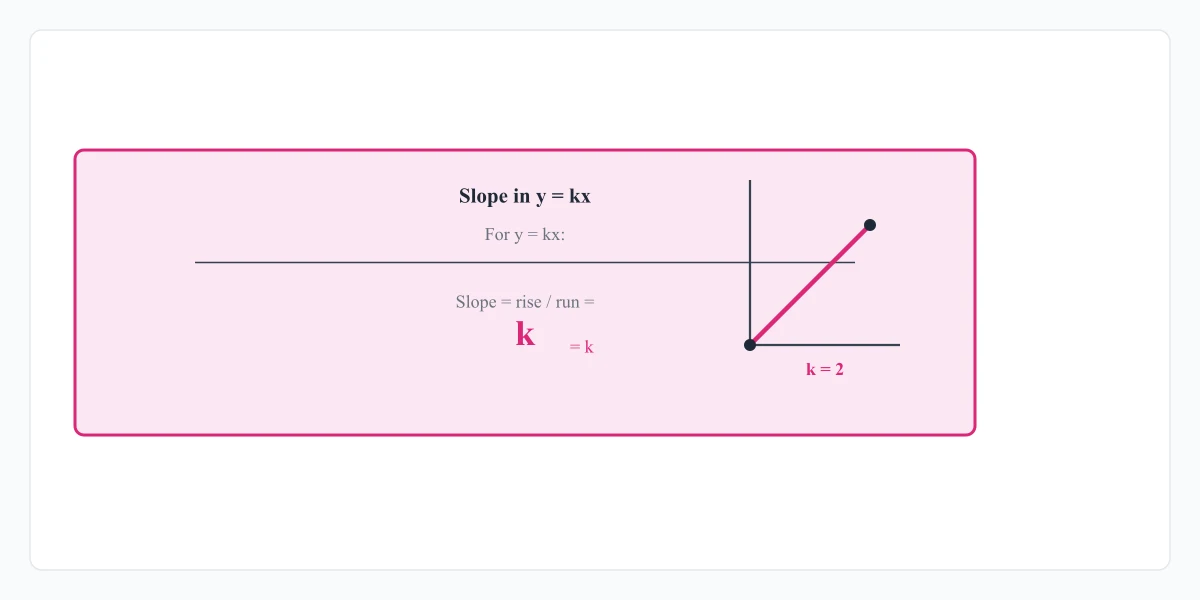
A wheelchair ramp rises 1 foot for every 12 feet of horizontal run. The steepness of that ramp — 1/12 — is its slope. If the ramp starts at ground level (height 0 at distance 0), that same number is also the constant of proportionality.
Slope and the constant of proportionality are the same number when a line passes through the origin. When it doesn't, they split apart. Here's exactly how that works.
What Slope Means
Slope measures steepness. It's the ratio of vertical change to horizontal change:
Take two points on a line, subtract their coordinates, and divide. The result tells you how much changes for each 1-unit increase in .
| Points | Rise | Run | Slope | |---|---|---|---| | and | | | | | and | | | | | and | | | |
Same slope every time. That's what makes a line straight.
When Slope Equals
A proportional relationship is a line through the origin: . The slope formula on this line gives:
The factors out and cancels the denominator. Slope is .
On a proportional line, slope, unit rate, and the constant of proportionality are the same number. Three names, one value.
When Slope Does Not Equal
The moment a line shifts off the origin — with — the relationship stops being proportional, and slope and unit rate become different numbers.
Take :
- Slope: (the line still rises 3 units per 1 unit right)
- Unit rate: Varies. At : , rate is . At : , rate is . Not constant.
The line has the same steepness. But the means is always 2 more than , so changes depending on which you pick. No single unit rate. No proportionality.
Rise Over Run as Unit Rate
On a proportional graph, pick any point where . The rise from the origin to that point is , and the run is .
This is why every point on a proportional line gives the same ratio. Each step right adds exactly units up.
Real-World Slope as Steepness
Slope isn't just a math formula. It describes real things:
- Ramps: A 1:12 ramp has slope . Gentle.
- Stairs: Building codes require rise/run between and . Steeper than most ramps.
- Roofs: A "6/12 roof" rises 6 inches per 12 inches of run. Slope .
- Highway grades: A 7% grade means 7 feet of vertical per 100 feet horizontal. Slope .
When the starting point is zero (ground level, flat ground, bottom of the hill), these slopes are also unit rates.
Free practice worksheet
Get a printable "Proportional Relationships Practice Pack" worksheet delivered to your inbox.
Practice Problems
Problem 1: A line passes through and . Find the slope and the constant of proportionality.
. The equation is .
Problem 2: A line passes through and . Find the unit rate.
Slope , unit rate , . All the same.
Problem 3: Line A is . Line B is . Which has a constant unit rate? Which has a higher ratio at ?
Line A is proportional — every point gives . Line B gives at and at . The ratio changes. Line B is not proportional.
FAQ
Is slope always the constant of proportionality? No. Only when the line passes through the origin. If with , slope is but the constant of proportionality does not exist.
What's the difference between slope and unit rate? Slope is the ratio of rise to run between any two points on a line. Unit rate is for a single point. They're equal on every point of a proportional line and different on a non-proportional line.
Can slope be negative in a proportional relationship? Yes. has slope and . The line goes through the origin pointing downward.
How do you find from slope? If the line goes through the origin, equals the slope. Calculate rise over run from any two points, and that's your .
What about — what's the slope? . Slope is the coefficient of when the equation is in form. No calculation needed.
Can you have slope without a proportional relationship? Yes. Every straight line has a slope. Only lines through the origin are proportional.
Why do 7th-grade standards connect slope and proportionality? Because proportional relationships are the simplest kind of linear function. Understanding that slope now makes graphing in 8th grade much easier.
Get free math resources
Join our newsletter and receive printable worksheets, practice sets, and tips for mastering proportional relationships.
No spam. Unsubscribe anytime.
Still stuck?
Get one-on-one help from a verified math tutor. Wyzant connects you with expert tutors who can walk you through proportional relationships step by step.
Find a math tutorRelated: Review the basics of or read about the constant of proportionality. Use the slope vs. unit rate calculator to compare both values on any line.
ProportionalRelationship Team
Math educator and content creator at Proportional Relationship.
Get free math resources
Join our newsletter and receive printable worksheets, practice sets, and tips for mastering proportional relationships.
No spam. Unsubscribe anytime.
Still stuck?
Get one-on-one help from a verified math tutor. Wyzant connects you with expert tutors who can walk you through proportional relationships step by step.
Find a math tutor