How to Tell if a Table Is Proportional
Learn the fastest way to check whether a table shows a proportional relationship using the constant ratio method, with examples and a free practice worksheet.
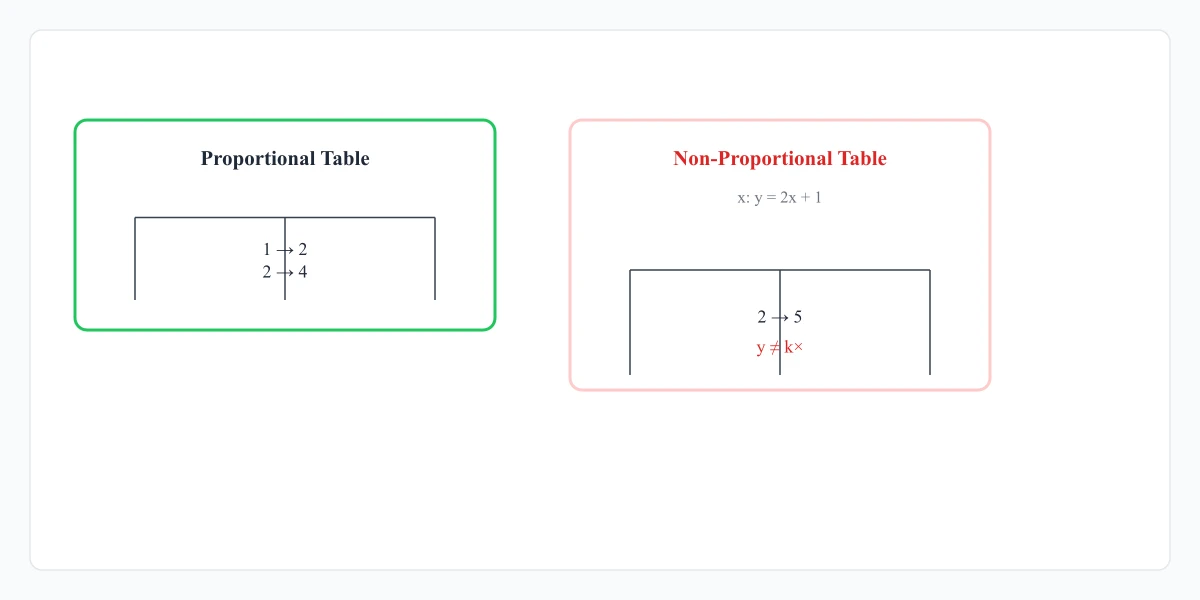
Here's a table:
| | | | :-: | :-: | | 2 | 8 | | 4 | 16 | | 6 | 24 | | 9 | 36 |
Is it proportional? You can answer in about 5 seconds.
The Constant Ratio Method
Divide by for every row. If every division gives the same number, the table is proportional.
For the table above:
Every answer is 4. That means , and the relationship is . Proportional.
Free practice worksheet
Get a printable "Proportional Tables Practice" worksheet delivered to your inbox.
Try a Non-Proportional Table
| | | | :-: | :-: | | 1 | 5 | | 2 | 9 | | 3 | 13 | | 4 | 17 |
Check the ratios:
The ratios change every time. Not proportional.
Notice the pattern: the values increase by 4 each time, and increases by 1. This follows — a straight line, but shifted up by 1. That extra constant is what breaks proportionality.
Why the Ratio Method Works
When two quantities are proportional, the ratio stays constant by definition. That constant is , the constant of proportionality, from the equation .
If the ratio ever changes, the relationship can't be written as , so it isn't proportional.
Common Trap: Adding vs. Multiplying
Students often confuse "increases by the same amount" with "multiplies by the same factor."
In a proportional table, when doubles, doubles. When triples, triples. That's multiplication by a constant factor, not addition.
Look at this table:
| | | | :-: | :-: | | 0 | 0 | | 1 | 3 | | 2 | 6 | | 3 | 9 |
increases by 1, increases by 3. But more importantly, , , . The ratio holds.
Now this table:
| | | | :-: | :-: | | 0 | 2 | | 1 | 5 | | 2 | 8 | | 3 | 11 |
increases by 1, increases by 3. Same addition pattern. But , — ratios are different. This is . The breaks proportionality.
The addition pattern looks the same. Only the ratio reveals the truth.
Step-by-Step Check
- Pick any row (skip if present — is undefined).
- Divide by .
- Repeat for another row.
- If the results match, check a third row.
- If all match, the table is proportional.
Use our proportional table checker to check any table instantly.
FAQ
What if the table has negative numbers? The same method works. Divide by for each row. If all ratios are the same (including negative), the table is proportional.
What if a row has ? Skip that row. is undefined. But if and , the relationship cannot be proportional (in , must be 0 when ).
Does the ratio need to be a whole number? No. can be a fraction, decimal, or even a negative number. The only requirement is consistency.
How many rows do I need to check? At least two (where ). Three is safer to rule out coincidence.
Can you have a proportional table with a missing value? Yes. If you know the constant of proportionality , you can find the missing value using .
Still stuck?
Get one-on-one help from a verified math tutor. Wyzant connects you with expert tutors who can walk you through proportional relationships step by step.
Find a math tutorRelated: Learn how to check graphs for proportionality, or read the full guide on what proportional relationships are.
ProportionalRelationship Team
Math educator and content creator at Proportional Relationship.
Get free math resources
Join our newsletter and receive printable worksheets, practice sets, and tips for mastering proportional relationships.
No spam. Unsubscribe anytime.
Still stuck?
Get one-on-one help from a verified math tutor. Wyzant connects you with expert tutors who can walk you through proportional relationships step by step.
Find a math tutor